


A Voice Reimagined
THE CONCEPT AND THE ARCHITECTURE BEHIND THE SOUND OF VESPER
It starts
with a choir.
What if a recorded voice could be represented in a mathematical formula and used as an oscillator? What kind of abilities would you have then to shape, stretch, and modulate the sound?
The starting point was the character of a choir: the shape of its vowels, the movement of its singers, the air between its notes.
Vesper begins with an actual recording of a choir. Spectral analysis extracts a changing mathematical description of its timbre: a sequence of spectral envelopes. Each envelope describes how the sound’s energy is distributed across frequencies. The instrument uses those shapes to build new pitched tones when you play a note.
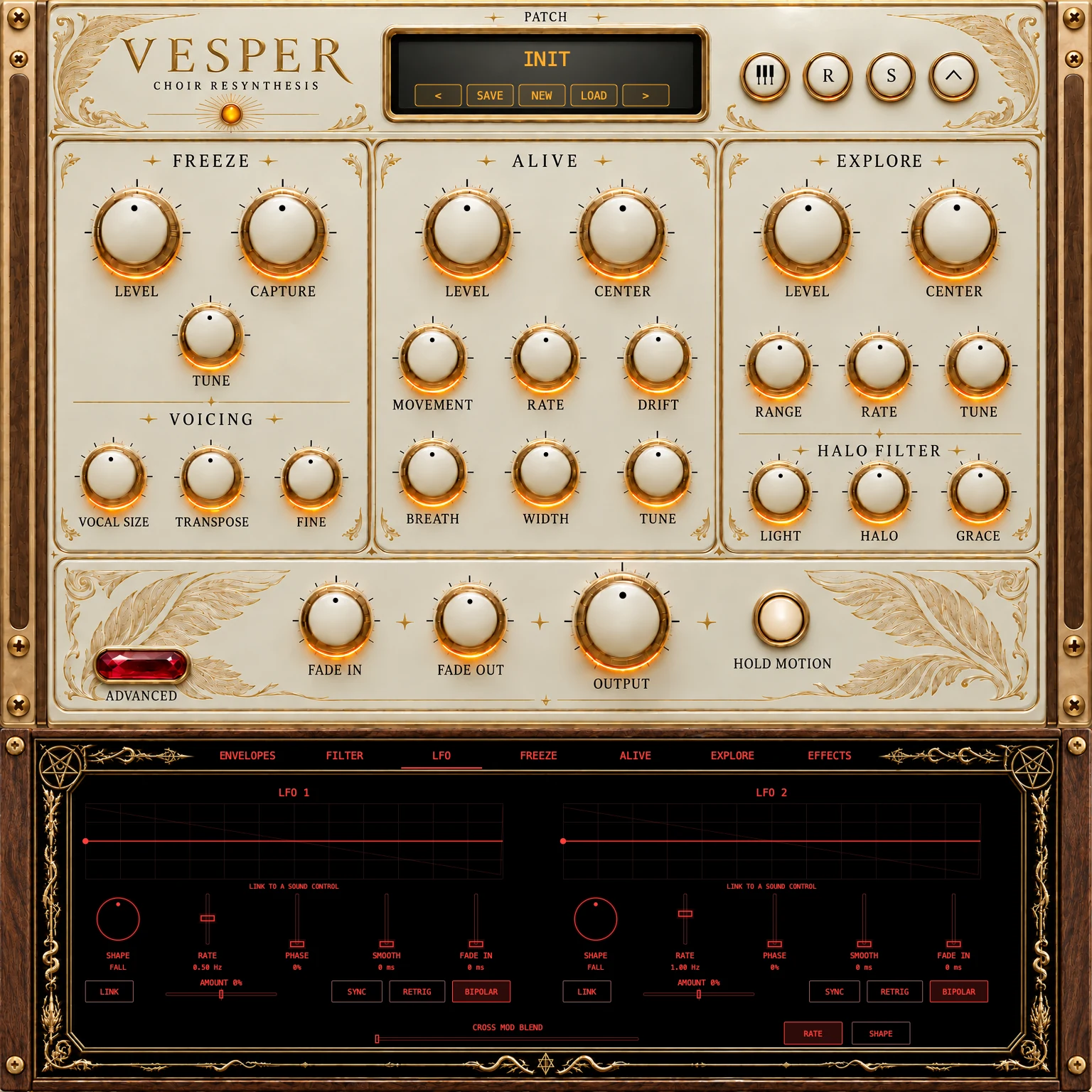
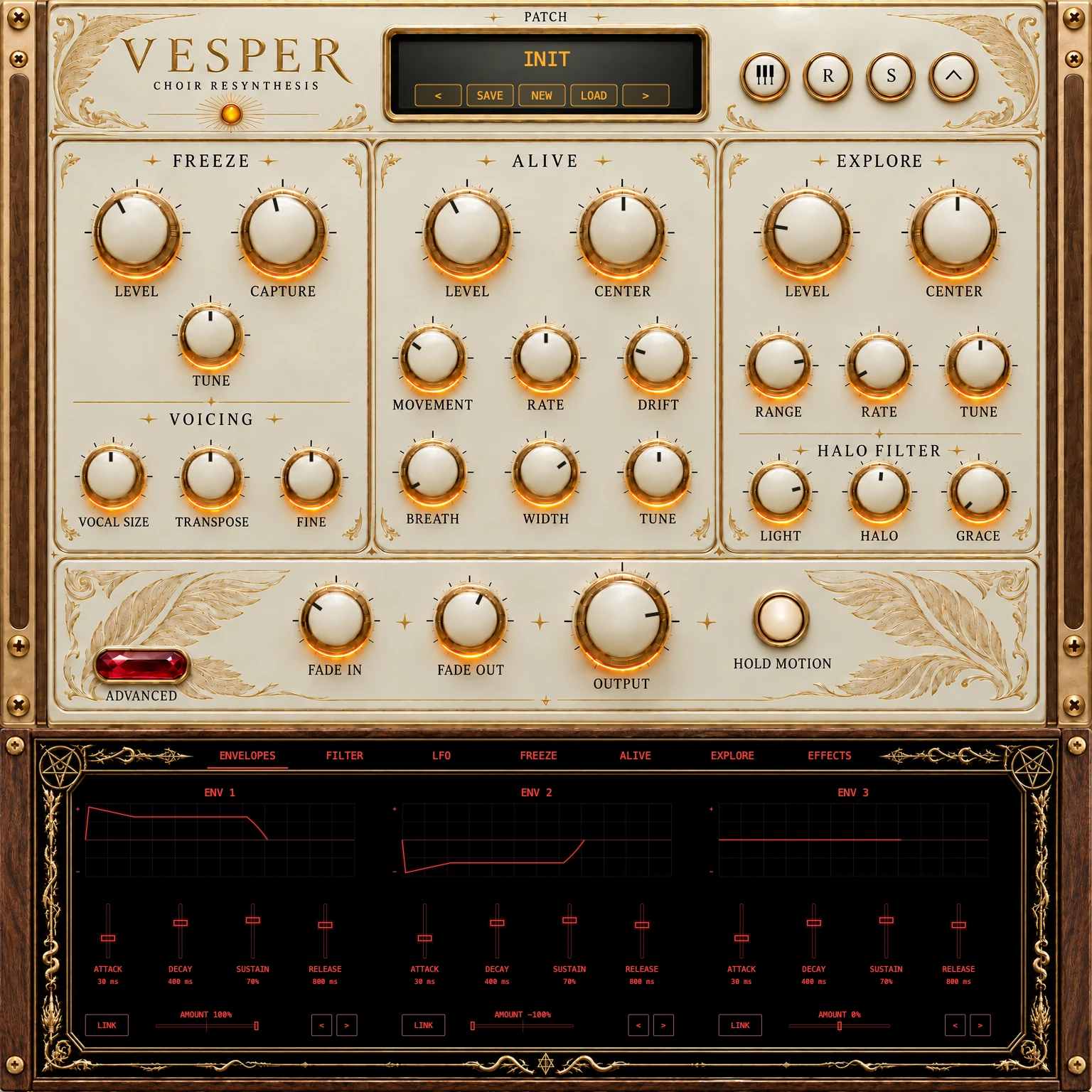
Three layers approach the same material differently. Freeze holds a selected spectral shape. Alive adds movement and the slight differences of an ensemble. Explore travels through the changing source. Blend them, tune them separately, then shape the result with filters and effects.
FROM VOICE TO INSTRUMENT
A look through the signal path.
Choose a stage to see how the sound is built.
A little further into the engine
The reference architecture uses 64 time frames and 512 frequency bins to describe its source. Additive oscillator banks build notes from harmonics, with up to eight note voices. Alive uses three detuned banks; Freeze and Explore use one each.
Recorded spectral shape and played pitch are handled separately. Vocal Size moves the spectral envelope, while Transpose and Fine change pitch. Upper harmonics are attenuated near the sample-rate limit, and control smoothing helps changes remain continuous.
Vesper extends this core with three envelopes, two LFOs, a morphing Halo filter, and chorus, delay, and reverb. Effects can be reordered. The architecture keeps sound processing separate from the graphical interface.