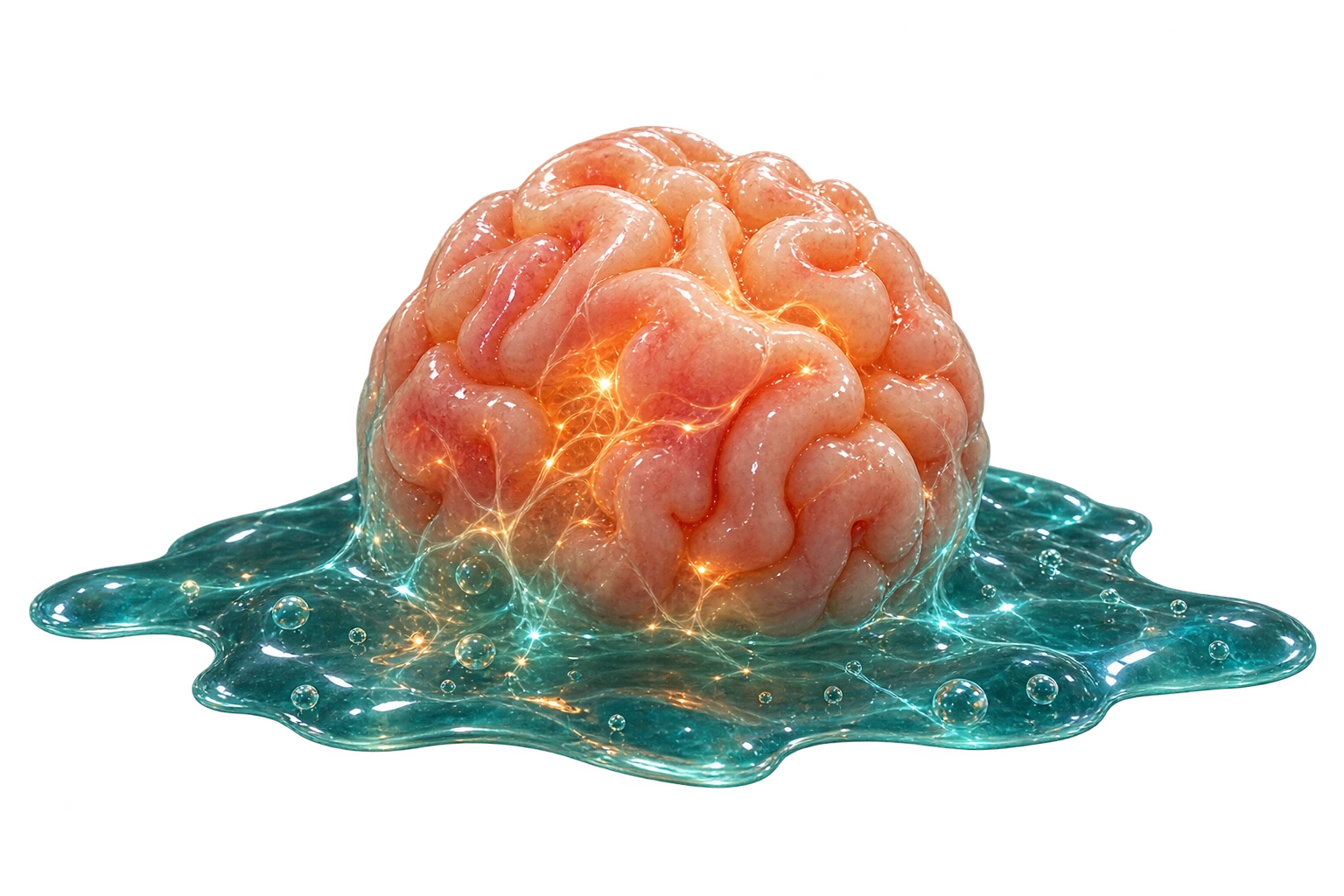
Stimulus
Energy enters the system.
Pitch establishes the note. Excite supplies energy; Density changes the balance of harmonic groups. Tissue moves those relationships toward metallic, inharmonic tones.

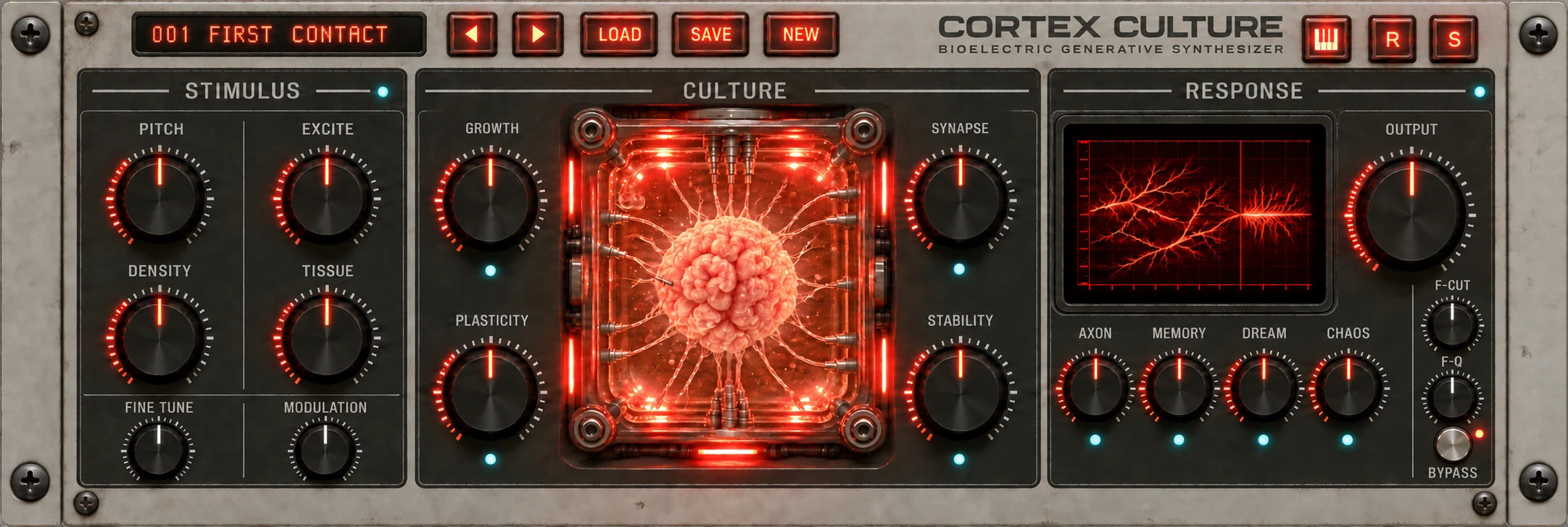
Swipe across the instrument to reach every control →
Start a phrase. Turn a knob.
See where the experiment takes you.
Press Play on the instrument. Every control in this demo is operational. Get a taste of how Cortex Culture could take your next score or track out of the lab—and into something extraordinary.
THE SCIENCE OF AN UNEXPECTED SOUND
Cortex begins with a question: what if a synthesizer behaved like a connected, adapting network? Instead of treating a held note as a fixed event, its modeled interactions let the harmonic character develop over time.
Pitch establishes the note. Excite supplies energy; Density changes the balance of harmonic groups. Tissue moves those relationships toward metallic, inharmonic tones.
Growth recruits overtones. Synapse couples neighboring groups; Modulation adds phase interaction. Plasticity softens upper harmonics over time, while Memory shapes how quickly that adaptation unfolds.
Axon distributes phase and stereo positions. Dream introduces slow spectral motion; Chaos adds irregularity around a stable fundamental. A membrane filter, envelope, and effects shape the final voice.
Harmonic balance, phase coupling, damping, and adaptation turn the biological idea into a playable sound engine. Stability restrains movement; Plasticity and Memory govern change through time. This is a stylized computational model inspired by biology, rather than a simulation fitted to biological recordings.
The original Cortex research notes reference open work on brain organoids: how networks develop, synchronize, and produce changing electrical rhythms. One reference is Tal Sharf’s 70.92 GB Dryad dataset of extracellular organoid recordings, collected with high-density electrode arrays and Neuropixels probes. Dryad publishes its research datasets under CC0.
That research provides context for the instrument’s network-inspired design: interacting groups, evolving activity, and a response that changes over time. Cortex turns those ideas into authored synthesis controls. Cortex uses an authored computational sound model; the open archive is a research reference, not a collection of recordings loaded into the instrument.
Research reference: Sharf, T. (2022), Extracellular Recordings from Human Brain Organoids Using High-density CMOS Arrays, Dryad, doi:10.25349/D9031Z. Research citation does not imply endorsement.

THE NEXT EXPERIMENT IS WAITING.